What is Hunch?
Hunch is a creative performance platform that helps advertisers build, launch and optimize paid social ads at scale on Meta, Snapchat and TikTok. It turns product feeds and other data into templated image and video ads, then pushes those ads into campaigns in bulk. Hunch is built mainly for ecommerce, retail and multi-location brands, plus the agencies that run their paid social accounts.
The platform focuses on three jobs: making catalog ads look like branded creative, producing localized ads for many markets or stores, and automating campaign setup from a spreadsheet. A shared dashboard pulls Meta, Snapchat and TikTok results together so teams can see which creative works. Hunch Insights Inc. lists itself as a Meta Business Partner. Prices are not published and are quoted after a demo. Hunch publishes comparison pages against Smartly, ROI Hunter and Marpipe, its main rivals.
Hunch at a glance
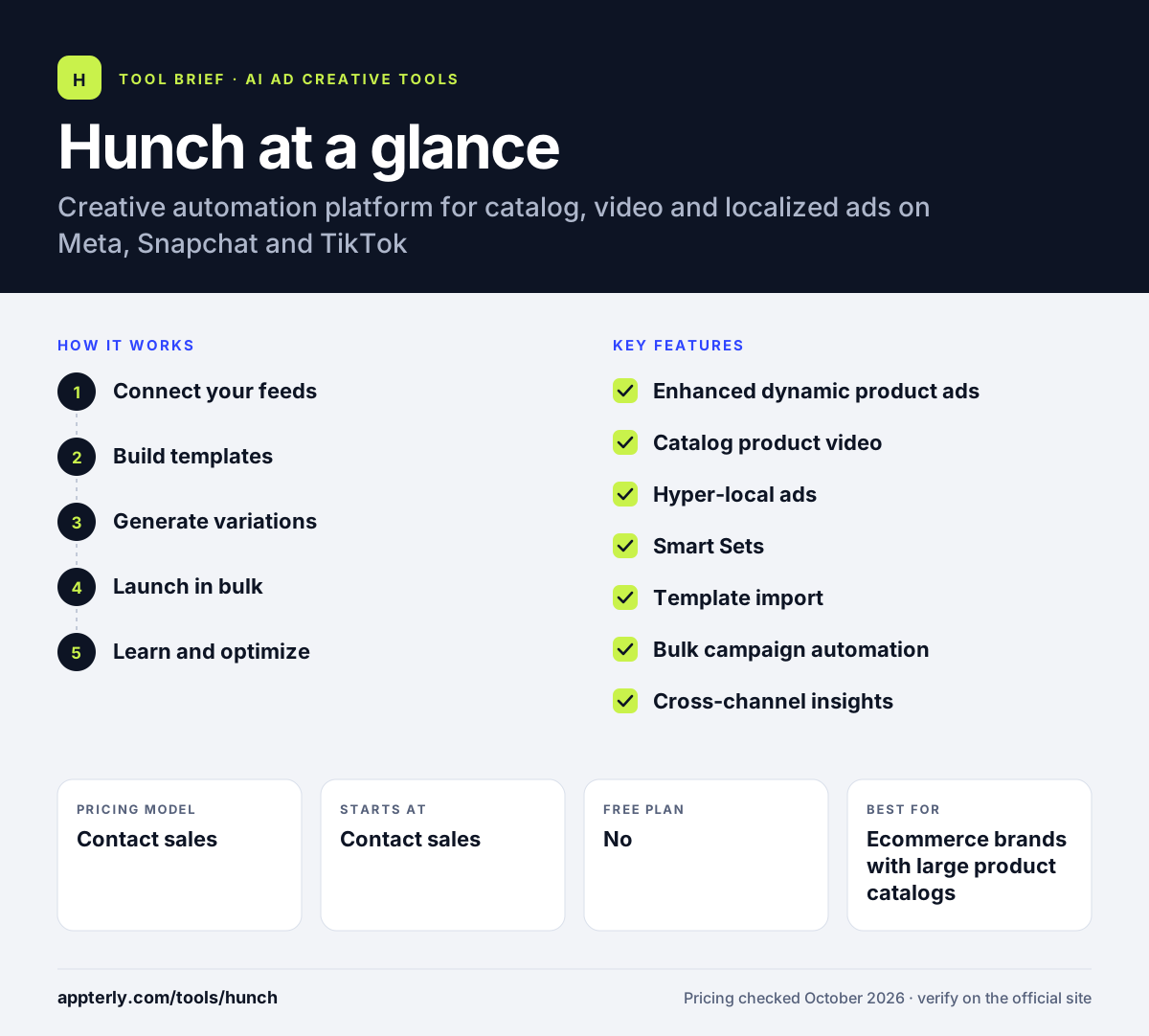
How does Hunch work?
- Connect your feeds
Link data sources such as a Shopify catalog or Google Sheets, then enrich the feed with custom fields like badges or local prices.
- Build templates
Design ad templates in Hunch or import Figma and PSD files, with placeholders that pull from the feed.
- Generate variations
Hunch turns one template into many image and video ads using live data such as pricing, discounts and locations.
- Launch in bulk
Set up campaigns from a single spreadsheet and publish them directly to Meta and Snapchat.
- Learn and optimize
Review combined performance data from each channel and adjust products, templates and budgets.
Hunch key features
Enhanced dynamic product ads
Restyles catalog items into branded ads with AI background removal and color matching, so product ads look less generic.
Catalog product video
Creates animated product videos straight from a product feed and refreshes them on a schedule as the catalog changes.
Hyper-local ads
Produces ads with local pricing, maps, language and offers for many regions or stores, managed from one control center. This suits franchises and retailers with many physical locations.
Smart Sets
Builds product sets from GA4 and conversion data and refreshes them weekly, helping spend go to products that sell.
Template import
Imports Figma and PSD designs and turns them into data-driven templates for images and video.
Bulk campaign automation
Launches many campaigns and ad sets at once from a single spreadsheet, which cuts manual setup in ads managers.
Cross-channel insights
Combines Meta, Snapchat and TikTok results in one dashboard for easier creative comparison.
Why use Hunch?
- It makes catalog ads more on-brand without designing each product by hand.
- Localized campaigns for many markets can be run from one place.
- Bulk launching saves hours of repetitive setup in ad platforms.
- Video ads can be generated from a product feed instead of filmed.
- Pricing is usage-based with no seat limits, according to Hunch.
Who is Hunch best for?
A good fit for
- Ecommerce brands with large product catalogs
- Retailers and franchises running localized ads
- Performance agencies managing paid social at scale
- Teams advertising heavily on Meta and Snapchat
- Multi-location retailers and franchises needing local pricing in ads
Less suited to
- Small businesses wanting transparent self-serve pricing
- Advertisers focused mainly on search or display ads
- Teams needing a general-purpose design tool
Hunch pricing
| Pricing model | Contact sales |
|---|---|
| Free plan | No |
| Free trial | Not confirmed |
| Starting price | Contact sales |
Hunch does not publish prices. It describes usage-based pricing with full access to AI tools and no seat limits, quoted after a demo.
Prices checked October 2026. Vendors change plans often, so confirm on the official website before you buy.
Hunch pros and cons
Pros
- Strong focus on catalog and product video ads
- Good tooling for localized, multi-market campaigns
- Bulk campaign launch from a spreadsheet
- No seat limits
Cons
- No public pricing or self-serve plan
- Core channel support centers on Meta, Snapchat and TikTok
- Most useful for advertisers with sizable catalogs or budgets
Hunch integrations and platforms
Works with
Available on
Hunch alternatives
See the full shortlist in Best AI Ad Creative Generators.
Hunch FAQ
What is Hunch used for?
Hunch is used to automate paid social ad creative and campaign setup. Advertisers connect product feeds, build data-driven templates and generate many image and video ads, including branded catalog ads and localized ads for different markets. Hunch then launches campaigns in bulk on Meta and Snapchat and reports results across Meta, Snapchat and TikTok.
How much does Hunch cost?
Hunch does not list prices on its website. The company describes a pay-for-what-you-use model with full access to its AI tools, no hidden fees and no seat limits. To get a quote, you need to request a demo, so the price depends on your ad volume and needs.
Is Hunch free?
No. Hunch does not offer a free plan or a public free trial on its website. Access starts with a demo, after which the team proposes a usage-based price. Small advertisers looking for a free tool may prefer simpler template tools, while Hunch suits brands with larger catalogs and budgets.
Hunch vs Smartly: what's the difference?
Both are creative and campaign automation platforms for paid social. Smartly is a broad enterprise suite that covers many channels, media buying and reporting. Hunch focuses closely on catalog ads, product videos and localized creative for Meta, Snapchat and TikTok. Hunch may suit mid-sized ecommerce teams, while Smartly targets large global advertisers.
Does Hunch work with Shopify?
Yes. Hunch can pull product data from sources such as Shopify and Google Sheets. It then enriches the feed with custom fields and uses it to build dynamic image and video ads, so changes in prices or stock flow into the ads automatically.
Sources
This overview is based on Hunch's official website and documentation, checked October 2026.