What is Shopify?
Shopify is an ecommerce platform that lets businesses build an online store, manage products and orders, and take payments from one dashboard. It includes a store builder with themes, a checkout, inventory tools and built-in payment processing. The same account can also run in-person sales through Shopify POS and list products on other channels, so online and offline sales share one product catalog.
Shopify relies on a large App Store with more than 13,000 apps for marketing, reviews, shipping and more, which lets merchants add features as they grow. Sidekick, its AI assistant, helps with store tasks and content. Plans step up from Basic to Grow, Advanced and Plus, with lower card rates, more staff accounts and more customization at each level.
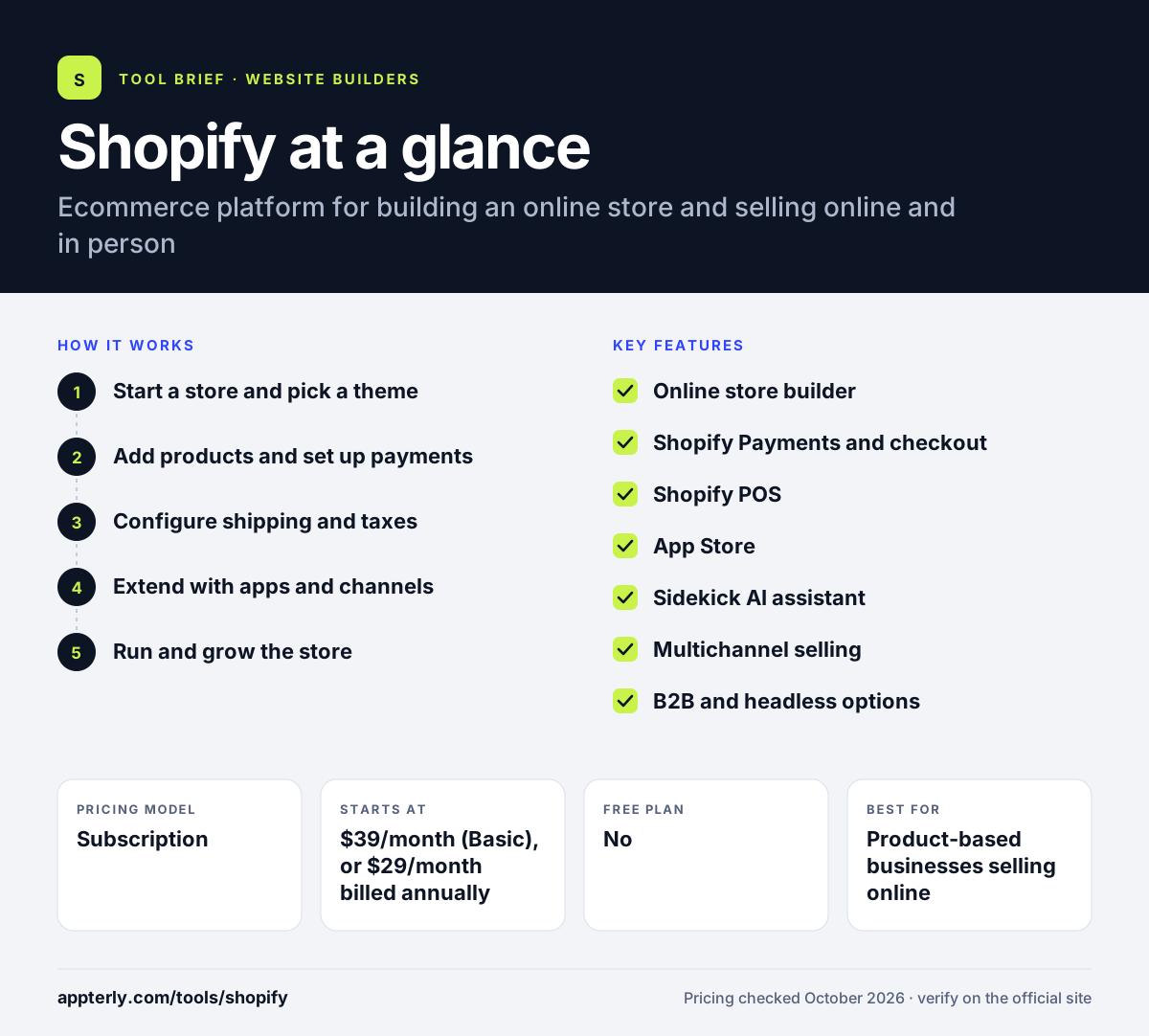
Shopify at a glance
How does Shopify work?
- Start a store and pick a theme
Sign up, choose a free or paid theme and customize it with the visual theme editor.
- Add products and set up payments
Upload products with photos, prices and variants, then turn on Shopify Payments or a third-party payment provider.
- Configure shipping and taxes
Set shipping zones and rates, connect carriers where your plan allows and set up tax rules.
- Extend with apps and channels
Install apps from the App Store and connect sales channels such as social platforms, the Shop app and in-person POS.
- Run and grow the store
Process orders, track inventory and review analytics, using Sidekick to speed up routine tasks.
Shopify key features
Online store builder
Themes and a no-code editor for creating a branded storefront that works on mobile.
Shopify Payments and checkout
Built-in card processing with plan-based rates, plus a hosted checkout. Third-party gateways carry an extra fee.
Shopify POS
Sell in person with the same catalog and inventory. POS Pro is a paid add-on per location.
App Store
More than 13,000 apps cover email, reviews, upsells, shipping, accounting and more.
Sidekick AI assistant
An AI assistant inside the admin that helps with store setup, content and everyday tasks.
Multichannel selling
Sell through the Shop app, social channels and AI shopping channels from one product catalog.
B2B and headless options
B2B catalogs and headless storefronts are available, with higher limits on the Plus plan.
Why use Shopify?
- Shopify covers store building, payments, shipping and POS in one system, which reduces the number of tools you manage.
- The large app ecosystem means most extra features can be added without custom code.
- Hosting, security and checkout are managed for you, so there is no server work.
- Plans scale from a solo seller to large brands on Shopify Plus without changing platforms.
- A low-cost trial lets you build and test a store before committing to a full plan.
Who is Shopify best for?
A good fit for
- Product-based businesses selling online
- Retailers that sell both online and in a physical shop
- Dropshipping and direct-to-consumer brands
- Growing brands that expect to add staff, apps and channels
Less suited to
- Content-heavy sites or blogs where selling is secondary
- Sellers who want to avoid monthly fees, since every plan is paid
- Merchants who rely on a third-party payment gateway and want to avoid Shopify's extra transaction fee
Shopify pricing
| Pricing model | Subscription |
|---|---|
| Free plan | No |
| Free trial | 3 days free, then $1/month for 3 months |
| Starting price | $39/month (Basic), or $29/month billed annually |
Plans are Basic, Grow ($105/month), Advanced ($399/month) and Plus (from $2,300/month). Higher tiers lower card rates and third-party transaction fees and add staff accounts, API capacity and checkout customization.
Prices checked October 2026. Vendors change plans often, so confirm on the official Shopify pricing page before you buy.
Shopify pros and cons
Pros
- Complete ecommerce toolkit with payments, shipping and POS
- Very large app and theme ecosystem
- Scales from small shops to enterprise brands
- Managed hosting and checkout
Cons
- App subscriptions can add a lot to the monthly cost
- Extra transaction fee when using a third-party payment gateway
- Blogging and content tools are basic compared with WordPress
Shopify integrations and platforms
Available on
Shopify alternatives
See the full shortlist in Best Website Builders.
Shopify FAQ
Is Shopify free?
No. Shopify has no free plan. New users can start with 3 free days and then pay $1 per month for three months on most plans. After that, the Basic plan costs $39 per month, or $29 per month when billed annually. Card processing fees apply on top of the plan price.
What is Shopify used for?
Shopify is used to build and run online stores. Merchants use it to list products, take payments, manage inventory and ship orders. It also handles in-person sales through Shopify POS and lets stores sell on other channels, so online and offline sales stay in one system.
Is Shopify good for beginners?
Yes. Shopify is one of the easier ways to launch a store because hosting, security and checkout are handled for you. Themes and the visual editor make setup simple, and Sidekick can help with tasks. The main learning curve comes from choosing apps and configuring shipping and taxes.
Shopify vs WooCommerce: what's the difference?
Shopify is a hosted platform with a monthly fee that manages hosting, security and updates for you. WooCommerce is a free WordPress plugin, so you handle hosting and maintenance yourself but get more control over code and costs. Shopify suits sellers who want simplicity, while WooCommerce suits those already on WordPress.
How much does Shopify charge per sale?
With Shopify Payments, online card rates start at 2.9% plus 30 cents on Basic and drop on higher plans. If you use a third-party payment provider instead, Shopify adds a transaction fee of 2% on Basic, falling to 0.2% on Plus. In-person card rates are lower than online rates.
Sources
This overview is based on Shopify's official website and documentation, checked October 2026.